
Everything I can think to mention about Bridges
Note: If I waited until I thought I'd answered every question players could have about bridges, this page would never get posted. So here are my comments so far, in no particular order:
Where should the bridge be located on my bass?
There are two cuts in each f-hole; your bridge's feet should be centered on the two inside cuts. Your bass is designed for that placement; I know some folks move it up or down from that position to adjust string height, but moving it away from the correct position is not a good idea for a variety of reasons, and it could "test" your instrument's structural integrity. The bridge should also be centered on the body, assuming your bass is symmetrical- if it isn't, that's another issue altogether.
Can I buy a new (adjustable or regular) bridge that will fit my bass?
No, not really. Though we do offer some "pre-fitted" bridges for 3/4 size bass that have some of the fitting work done, there's still a good bit of fine-tuning to get it to fit your particular bass. New bridges do not come in pre-cut, drop-on sizes to fit each instrument, as basses differ from one another - even two basses from the same manufacturer, that were built on the same day, will have some differences. You will find all replacement bridge blanks to be considerably taller than your current bridge -- they always need to be cut, trimmed, and shaped to fit. Neck angles as well as other construction details results in different bridge heights and widths. The key issue for choosing a replacement bridge is the width of the feet (see next item for details).
How do I choose the right size bridge?
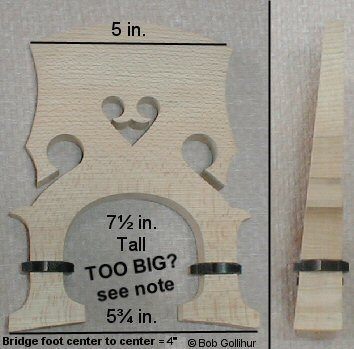 Look or feel inside your bass through the E string f-hole, and you will see the bass bar, a long piece of wood glued to the inside of the bass top. If you measure from the middle of the bar to the mid-point of the bass, and then double the measurement, you have now discovered the optimal measurement of the bridge's feet when measured from center to center to fit your bass.
Choose a replacement bridge as close to that range as you can (most basses are 3/4 size, with bridge feet four inches apart when measured from center to center). Height shouldn't be an issue as most bridge blanks are much higher than needed, and you'll need to cut it down to fit properly.
These are the measurements (approximate) of the bridges I sell from bridge feet center to center:
3/4 size: 4 inches
1/4 size: 3 3/4 inches
1/2 size: 3 7/8 inches
7/8-4/4 size: 4 3/4 inches
Fit: How well should the feet fit?
The bridge feet should be perfectly shaped to match the top of the bass, for maximum sound transfer. There are tricks to do this; email me if you'd like to take a look at the installation instructions I've written, which include some of these "tricks of the trade."
That fit is a critical ingredient in achieving the best sound from your bass. The top part also still needs to be cut and shaped on that type of bridge, so given the work you still have to do, IMHO it's hardly worth the much higher cost for the fancy swivel-foot bridges.
Do I need an adjustable bridge?
There are many reasons for installing an adjustable bridge; here are some of them:
- Carved basses generally move with the seasons, and adjusters allow the player to keep a consistent string height as the bass expands or shrinks.
- Whether carved or laminated, some players prefer different action for differing styles. Adjusters allow you to make those changes for an amplified modern jazz gig on Friday night and an acoustic bluegrass jam on Sunday.
- Some laminated basses also move a little, but regardless, sometimes it's good to be able to make minute adjustments to "fine tune" the bass to your preference. With a solid bridge, unless you're ready to break out the tools, whatever height to which the bridge is cut is the way it is.
Okay, but will bridge adjusters affect the sound of my bass?
Possibly, everything does, but by how much?? The effect of adjusters on tone is very often overstated, usually by people who have a "purist" view of what an instrument should be. And it's fine for everyone to have an opinion, but it's better if the opinion you form is based upon reality or experience. There is a link to a site (on my Double Bass Links Page) with a scientific study of the effects of adjusters of various materials, using specialized audio equipment. The sophisticated gear could differentiate between fixed and adjustables, as well as different adjuster materials (like aluminum, brass, Delrin, etc.) but I think you'll find a huge number of bassists have chosen to use adjustable bridges, as these differences are quite subtle - if not undetectable - to the "naked ear." Quality of wood, and how well the bridge is contoured and fitted are two far more important variables in quality of sound, for sure. A true "on-bass" test is near impossible, as you'd need to equalize those variables and be able to A-B fairly once the bridge was properly fitted on the same instrument, with the same strings, in a "blind" comparison.
In my personal opinion and experience, a fellow player or luthier who is telling you that you can "hear" a difference between and adjustable bridge and a fixed one is probably basing that opinion on flawed experience -- or they're "hearing with their eyes." I very happily use adjustable bridges on my own basses, and I certainly don't feel that I'm sacrificing anything significant in the way of sound -- if I did, they wouldn't be on there, and I would sell them with a caveat attached.
If you choose to disagree, though - that's fine as well; we sell both fixed and adjustable bridges.
Bridge height
You may not want to make your bridge too short and action too low at the bridge. Most players should leave enough height for good tone and room for string "bloom." If your bass is tough to play at the lower positions near the top of the fingerboard, it's the height of the nut (and depth of the "scoop" that should be in the face of the fingerboard) that may need addressing-- lowering the bridge a little won't have a significant effect on the action at the nut.
The top of the bridge -- string spacing and slots
The spacing of modern 3/4 size instruments varies from 7/8" to over one inch, and can be dependent on the fingerboard width and personal preference. One thing that should not be overruled is the depth of the indentations for the strings. That's right, indentations -- not slots! They should be no deeper than 1/2 the diameter of the string, enough to keep the string in place but not so deep as to "pinch" the string, which can interfere with tone. Too wide and you invite buzz. Round is a good shape, and it should be smooth and tapered on both sides, where the string enters and leaves the bridge. Sharp edges and narrow slots can snag or choke the string and damage it, as well as grab the bridge and move it as you tune. Graphite (rub some onto the position using a soft lead pencil) lubricates the slot and helps keep things smooth.
Tips for maintaining a healthy bridge
Keep an eye on the attitude of the bridge; it should be perpendicular to the top of the bass. Over time, due to continued tuning along with the fact that no bassist can walk through a doorway three times without bumping into it at least once, bridges move. The usual result is a bridge leaning towards the fingerboard- not a good thing, as foot contact is important, and that lean may earn you a warped bridge. Readjust it as needed; loosening tension a little and applying a gentle karate chop (ouch, that hurt, maybe I'll be smart enough to use the spine of a book next time) at the top of the bridge to realign it is a good idea.
Back To: Knowledge Base (FAQs)