
'Standard' Sized Strings on Large-size Basses
Note: The information on this page is still valid and helpful, but a more complete article has been created that provides far more information, including specific string data. CLICK HERE for that article.
Most of the basses on the planet are 3/4 size, so when somebody refers to "full size" one can usually assume that the instrument in question is actually a 3/4 size bass. Even if the bass legitimately is "oversized" -- as I mention in my Double Bass Sizing FAQ -- there are no strict dimensional "standards" for basses that are labeled as 7/8 and 4/4 size. So, you can't assume that two different so-called 4/4 sized basses will have the same dimensions. They can, in fact, vary a great deal. And even some basses that are identified by their maker as 3/4 sized can have design factors that create a need for strings that are longer than "normal" 3/4 size strings.
It is for this same reason that we won't know if a "standard" set of strings will fit your 7/8 or 4/4 size bass - since the dimensions of 4/4 basses can vary, a particular set of strings may fit "4/4 Bass A" but not fit "4/4 Bass B." So how can you be sure?
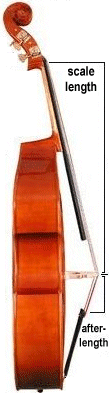
You'll see two measures in the image on the right:
Scale Length (mensur) - the speaking (vibrating) length of the string from the nut to the bridge
Afterlength - the distance from the bridge to the tailpiece
An "average" 3/4 size bass has a scale length in the neighborhood of 41-42 inches with an afterlength around seven inches. However, the afterlengths on a 3/4 size bass can vary, as the size of the tailpiece - and its placement in relation to the bottom of the bass - will affect those measurements. Therefore, if your larger bass is reasonably close to those numbers, a "standard" length string will probably do.
Most "standard" strings are designed for 3/4 and 4/4 size basses. Some have specific sets for each (Thomastik Spirocore is a common example, but the vast majority of players use the S42 set for both 3/4 and 4/4 sized basses.) Some, like the Zyex strings from D'Addario, have a special 4/4 length E-string (since its machine is the closest to the nut) but the A, D, and G strings all fit 3/4 and 4/4 sized basses.
If you believe that you have a larger than normal bass, measure the Scale Length and Afterlength as defined in the image to the right, and add them together. If the number exceeds 49 inches, let us know which string interests you. We can then measure the string and verify that it will be appropriate for use on your bass (or suggest an alternative that will be).
Back To: Knowledge Base (FAQs)