
Double Bass Sizing FAQ
Bass sizing is not an exact science. Rule #1: There Are No Rules.
The Double Bass (a.k.a. Upright Bass) is an instrument that only recently evolved over the last few hundred years, that is still being made by hand by individuals who build them to satisfy their own interpretation of the instrument. There are quite a lot of variances in sizing and design. But there are some conventions that many basses share, so we have this information here. Just be aware that the numbers here may not match up with your particular instrument -- and that's okay.
Rule #2: 3/4 size is recognized as the "regular" size bass.
I know, that sounds wrong, but "Full Size Bass" is a bit of a misnomer. This is a weird quirk that is unique to the upright bass. Every other stringed instrument (and a selection of other instruments, as well) consider 4/4 size to be the full-size, common instruments for adult players. Many of them have "downsized" instruments that are generally used for younger students (with their smaller limbs) and you generally are expected to graduate to the full-size instrument when your hands and arms grow larger. But in the bass world, we're a little different, and you can read why, below.
Just know that the vast majority of the basses on the planet are 3/4 size. You'll find that the 4/4 size bass is really considered more of a "jumbo" or "XXL" bass - and mostly they are used by bassists in orchestras, where acoustic volume and fullness is very important, and the extra depth can be advantageous for those using E-string extensions for added low notes (usually down to a low C).
So don't be compelled to purchase a 4/4 size bass because you think it's "better" than a 3/4 size bass, or you believe that you need to have a "full size" bass. Playing double bass can be quite a challenge, and if you are tall and/or have big hands, be thankful. You will find playing 3/4 size basses less of a challenge than us short folks with small hands. Generally speaking, a 4/4 bass is not going to automatically be "better" than a 3/4 size bass -- your selection should be based on the instrument and your specific needs, among other factors. Size, in this case, may not matter, unless bragging rights are important to you.
Also important: from a practical perspective, the selection of accessories is far more limited for 4/4 basses - as manufacturers generally focus on the products that are most popular (in this case, 3/4 size bass accessories) it's harder to find cases and strings that are reliably sized for 4/4 basses, as they simply don't make as many (or as many varieties).
Just remember, playing bass isn't like competitive diving - you don't get extra points for degree of difficulty.
Sizing - some examples
All of the above said, the information below shows some generally accepted guidelines for bass sizing. I am guessing that some of the original numbers were stated in Metric and were converted for U.S. use, which accounts for the uneven numbers. Again, keep in mind that these are approximate numbers for general reference purposes only. As we emphasized above, these numbers are not "standards" or even "recommendations" - they are simply conventions that have evolved as relative norms. But every bass maker is free to interpret the "best" dimensions based on their experience and expertise.
Note also that it's not uncommon to have some measurements on your bass correspond to one size, and others correspond to another. For instance, your bass may have a 3/4 scale, but an oversized body that measures like a 4/4 bass. Or perhaps it has some other combination, like the Kay and Engelhardt Maestro Junior models, with their (roughly) 1/2 size body and 1/4 size scale. Like I said - it's not an exact science!
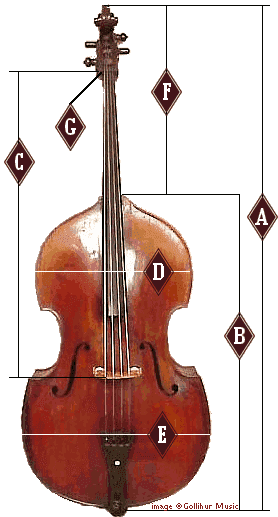
| All measurements are in inches | 4/4 | 3/4 | 3/4 Kay | 1/2 | 1/4 | |
| A - Full Height - bottom of body to scroll | 74.8 | 71.6 | 71.6 | 65.7 | 61.4 | |
| B - Body Height - bottom of body to shoulder | 45.7 | 43.7 | 43.7 | 40.2 | 37.4 | |
| C - Scale Length - Nut to bridge, aka playable length | 43.3 | 41.3 | 41.5 | 38 | 35.4 | |
| D - Upper Bout Width | 21.3 | 20.3 | 20.25 | 18.7 | 17.3 | |
| E - Lower Bout Width | 26.8 | 25.6 | 26.5 | 23.6 | 21.9 | |
| F - Scroll to Shoulder | 29.1 | 27.9 | 28 | 25.5 | 24.0 | |
| G - Width of Neck at Nut | 1.8 | 1.7 | 1.6 | 1.6 | 1.5 | |
| © Copyright Gollihur Music - When using this information, remember, these are "conventions," not "standards." | ||||||
Why is 3/4 size considered the "Full Size" bass?
So I've done a lot of reading on the subject, and while I'm far from an expert on bass history, I strongly believe that it's a simple practical matter of the evolution of the instrument. Because the bass - and more pertinently, its strings - have improved over time, it made such a physically huge instrument less necessary for volume and tone/pitch quality.
Originally, the instrument was called a "double bass" because it was created for use in very large orchestras to "double" the cello parts, one octave down. This gave a newly grand, full-bodied, and powerful low end to orchestras of the time. The double-basses used all-gut strings (which was all they had at the time), and were, therefore, necessarily huge, unwieldy instruments. As you can rightly imagine, with a large scale length and massive, floppy strings, they must have been an absolute beast to play.
The development of the over-wound gut string, and later, strings made of steel and other materials -- greatly improving the tone, pitch, and playability of the ere-while massively thick low strings -- quite likely saved the double bass from extinction. This improvement in strings alone provided access to much better-sounding lower notes, while also allowing the instrument to be resized to its far more practical current dimensions, which was dubbed a "3/4 size" bass, since it was smaller than the previously existing basses.
While the size nomenclature can be confusing, especially to those new to the instrument, it all helped to evolve the bass into a legitimate instrument of its own standing, no longer relegated to simply doubling the parts of other instruments.
Should I Use a 1/2 or 1/4 Size Bass for Portability Reasons?
This is a common question; some folks are interested in "sizing down" by getting a smaller bass to "lighten the load" of gigging. You know, getting a 1/4 size bass, putting a pickup on it, and using that instead of the bigger 3/4 size "standard" bass. This would presumably make for a "gigging" or practice instrument that would be smaller, lighter, easier to transport, etc.
There are people successfully doing this, but I personally find it to be a dubious solution. Here's why:
- A 1/2 size or 1/4 size bass is smaller, yes - but is it really smaller enough to make much difference? Most of the dimensions, you're looking at about a 15% reduction. And maybe 2-3 lbs. It still means you need a hatchback, and two hands to carry the beast.
- Now you need to add an amplifier and related gear to your rig, where maybe before you didn't. That's a net increase in gear to lug back and forth.
- Switching back and forth between your main bass' 3/4 scale (usually around 41.5") and a 1/2 or 1/4 size bass (usually 35-38") can be confusing for your muscle memory, and cause intonation issues.
- You'll have trouble obtaining suitable strings/accessories for the smaller size basses, as there is a significant reduction in choices available. For instance, whereas we offer dozens of string options for 3/4 size basses, there are only a handful for 1/2 size - and perhaps 4-5 for 1/4 size. And there are far fewer case options for those smaller sized basses.
- Some pickups can have a less balanced/less full tone on the smaller sized instrument, as they weren't really designed for the smaller bridge or string width of the small-scale bass.
I hope that all makes sense. And don't let me fully dissuade you from using such an instrument for those purposes; as I said, there are people doing it successfully. Everyone is different and what works for one person may not be ideal for another. But I just wanted to give you some food for thought before you made the jump.
FWIW, my preference is to go with a good electric upright bass, which will (usually) retain the full scale and playability of your 3/4 size upright bass, but in a far more portable package.
Choosing a Bass for a Young Student
Steve Freides is a longtime customer (and private bass teacher in Ridgewood, NJ - see his listing in our Teacher Directory) -- he offers this helpful, thoughtful consideration on choosing a bass size for a child learning bass:
Your web page implies - quite correctly, in my opinion - that a 3/4 size bass is the right size for the overwhelming majority of adults. I'd like to add three points based on my own experience in the world of basses and teaching bass, a chronology of basses through the course of a life, if you will:
- Starting Out: The overwhelming majority of 5th grade students should be playing a 1/4 size bass. I see a lot of 5th grade bass students. I have yet to meet a 5th grader for whom a 1/4 size bass isn't the right size. It's not too small even for someone 5 feet tall or a little over in the 5th grade. The reach is challenging for everyone new to double bass, and - this is the most important point - it's better to have the bass be a little too small than a little too big for elementary school-aged children.
I have, however, had some students for whom a 1/4 size double bass was still too big and for them I own a 1/8 and a 1/10 size bass. The 1/10 is the size of a 4/4 adult cello. In a pinch, one could use an adult-sized cello as a 1/10 size double bass by using appropriate strings and tuning - Gollihur has Helicore 4ths tuning strings for cello, but they're tuned up one octave from standard bass pitches. For proper octave tuning, you could perhaps use 1/8 size bass strings to keep the tension from being too high. - Transitioning to Adult Size: Although 1/2 or 5/8 sized basses are nice, most students can successfully transition without one, moving from a 1/4 directly to a 3/4 sized instrument. The age at which they do this will depend on when they grow and how big they are. I've had students play a 1/4 all the way through the end of 8th or even 9th grade then switch to a 3/4 size for high school, and I've had students to move to a 3/4 size in 6th grade because they're a lot taller than average (and usually, so are their parents).
- When You've Stopped Growing: My own bass teacher is 6' 5" and doesn't play a 4/4 - he plays a 7/8 size. If you think you need bigger than a 3/4 sized bass, well, think again. You may decide, of course, that you like or want a bigger bass, but "like" or "want" isn't the same as "need." Unless you're big enough to have considered basketball as a career, you'll be fine with a 3/4 size bass - and even then, a 3/4 may be the right size for you.
Thanks, Steve!
Back To: Knowledge Base (FAQs)