
Upright Bass Wheels
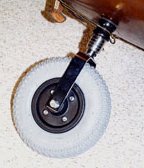
There are wheels available (we sell 'em, too) that can be inserted into the bottom of your bass. They're great - I have certainly appreciated having one when I had to cover long distances between car and gig.
 Installing:
You simply remove the endpin shaft (ok, sometimes it's not "simply" -- some endpins have a crossbar or other mechanism on the inside of the endpin that prevents it from falling out. In that case, you just shove the endpin into the bass, retrieve it from a f-hole, and remove or grind off whatever is preventing its removal.) and slide the wheel's shaft in. Good wheels have a flat side on the shaft that you can orient towards the thumbscrew, so you can use it to keep the wheel locked into the right direction.
Choosing:
It's important to choose the correct shaft size, so you'll probably have to measure the bass' endpin shaft. The most common size is 10mm (about 3/8 inch), followed by 8mm. Kays and Engelhardts with original endpins (all steel, both shaft and the receiver) are 1/2 inch; that size is typically only found on those brands, and keep in mind that some folks remove and replace those endpin mechanisms.
If you don't have a caliper, micrometer, or other device to measure the shaft, there are ways to get around that. My personal favorite is to go out to the garage and grab a few open-ended box wrenches (both SAE and Metric) - find the one that fits around the shaft the most perfectly, and read the size right off the wrench. No mechanic in the family? Get a piece of stiff cardstock or cardboard, and cut a notch in it. Continue to slightly widen that slot until the endpin fits perfectly - then measure the gap with a conventional ruler. Do the measurement with both inches and millimeters; as you can see, shafts are available in both metric and SAE (inches) sizes, and some of the sizes are very close.
Consider the bass and wheel you use; they are designed for use on relatively flat surfaces - but how much "give" there is in the wheel as well as the fragility of the bass still has to be considered. I use one of the less expensive wheels with my Kay because it is a laminated instrument, and while the wheel has some softness to absorb shock, the bass can take the vibration. My carved bass is more fragile and would call for the Gaines' pneumatic wheel, as it offers more shock absorption. Regardless, it's usually best to lift your instrument over rougher surfaces that might transmit too much shock. Please, don't jump the curb!
Using:
I like aligning my wheel so my bass rolls sideways-- I lean the bass shoulder into my right shoulder, reach over to grab the case handle or upper bout, and roll forward. You'll get the hang of steering in no time (people usually get out of the way when they see it coming, so who cares?)
Bass Wheel Alternatives:
There are some basses that cannot effectively use an endpin wheel. For instance, some endpins use a retainer thumbscrew that doesn't simply "jut against" the endpin, but rather tightens a collar around the entire endpin. Since this type does not press directly against the flat spot on the wheel's shaft, it cannot prevent the wheel from rotating. This is a bad thing; imagine walking at a good clip, and suddenly the wheel flips sideways. Not good.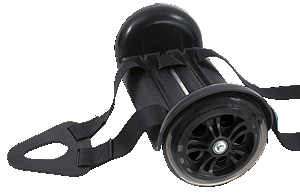 You might also have a non-removable endpin, or a solid wood non-adjustable one.
Don't worry, there is an option for you: The Bass Buggie is a small two-wheeled "cart" of sorts that quickly straps onto your bass and makes it as easy to "drive" as a hand-truck. It's one of my favorite products, and it solves most of those issues that make a bass wheel impractical or unusable.
Installing:You simply remove the endpin shaft (ok, sometimes it's not "simply" -- some endpins have a crossbar or other mechanism on the inside of the endpin that prevents it from falling out. In that case, you just shove the endpin into the bass, retrieve it from a f-hole, and remove or grind off whatever is preventing its removal.) and slide the wheel's shaft in. Good wheels have a flat side on the shaft that you can orient towards the thumbscrew, so you can use it to keep the wheel locked into the right direction.
Choosing:
It's important to choose the correct shaft size, so you'll probably have to measure the bass' endpin shaft. The most common size is 10mm (about 3/8 inch), followed by 8mm. Kays and Engelhardts with original endpins (all steel, both shaft and the receiver) are 1/2 inch; that size is typically only found on those brands, and keep in mind that some folks remove and replace those endpin mechanisms.
If you don't have a caliper, micrometer, or other device to measure the shaft, there are ways to get around that. My personal favorite is to go out to the garage and grab a few open-ended box wrenches (both SAE and Metric) - find the one that fits around the shaft the most perfectly, and read the size right off the wrench. No mechanic in the family? Get a piece of stiff cardstock or cardboard, and cut a notch in it. Continue to slightly widen that slot until the endpin fits perfectly - then measure the gap with a conventional ruler. Do the measurement with both inches and millimeters; as you can see, shafts are available in both metric and SAE (inches) sizes, and some of the sizes are very close.
Consider the bass and wheel you use; they are designed for use on relatively flat surfaces - but how much "give" there is in the wheel as well as the fragility of the bass still has to be considered. I use one of the less expensive wheels with my Kay because it is a laminated instrument, and while the wheel has some softness to absorb shock, the bass can take the vibration. My carved bass is more fragile and would call for the Gaines' pneumatic wheel, as it offers more shock absorption. Regardless, it's usually best to lift your instrument over rougher surfaces that might transmit too much shock. Please, don't jump the curb!
Using:
I like aligning my wheel so my bass rolls sideways-- I lean the bass shoulder into my right shoulder, reach over to grab the case handle or upper bout, and roll forward. You'll get the hang of steering in no time (people usually get out of the way when they see it coming, so who cares?)
Bass Wheel Alternatives:
There are some basses that cannot effectively use an endpin wheel. For instance, some endpins use a retainer thumbscrew that doesn't simply "jut against" the endpin, but rather tightens a collar around the entire endpin. Since this type does not press directly against the flat spot on the wheel's shaft, it cannot prevent the wheel from rotating. This is a bad thing; imagine walking at a good clip, and suddenly the wheel flips sideways. Not good.
You might also have a non-removable endpin, or a solid wood non-adjustable one.Don't worry, there is an option for you: The Bass Buggie is a small two-wheeled "cart" of sorts that quickly straps onto your bass and makes it as easy to "drive" as a hand-truck. It's one of my favorite products, and it solves most of those issues that make a bass wheel impractical or unusable.