
Do You NEED a Preamp with Your URB Pickup?
You might, but you might not. It depends on several factors.
Before you decide, though, do you already have an amp that you intend to use with your bass? If you are in the market for an amp, you can make some choices while shopping that can have an impact on whether you will need a preamp.
Starting with the Basics
If you are like most of us, you are using a piezo-electronic transducer for a pickup. That means you have a small ceramic-encased "sensor" that captures the vibrations created by the strings, turns those vibrations into electrical impulses, and sends them through the cable to an amp. The amp reverses that process, turning those impulses back into vibrations on the speaker of the amp, which makes sound waves and projects them into the room.
A preamp can further "improve" those electrical signals from the pickup. It can do this by boosting their gain levels, allowing for changes to the sound (using equalizers, etc.) -- and, in the case of the specific type of pickup (piezo-electric) in the bass, creating an ideal "buffer" (a sort of electronic "liaison") between the instrument and amplifier. But this buffer could already be built into the amp, if you choose that amp wisely, which may negate the need for an "extra" preamplifier or effects unit.
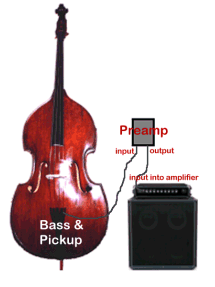 The "buffer" I speak of is related to electrical resistance, which is (in layman's terms) the degree in which the amplifier's circuit "resists" the pickup signal. The level of resistance (called input impedance) can radically change how a pickup sounds; when a pickup is well-paired to its preamp or amp, the result can sound full-bodied, natural, and open. That same pickup and amp, with the "wrong" level of buffering, can sound "quacky" or thin... essentially, completely out of whack, and sounding like you need to do a lot of EQ correction to even make it sound passably good.
Why? Put simply, when you plug your pickup into an amplifier, it becomes part of one big cooperative circuit. If the loading (amount of resistance) is not optimal for the type of pickup, problems result. The reason that this happens - without getting too technical - is because a "non-optimal" resistance load creates a sort of unintentional (and usually undesired) filtering effect which may decrease the level of certain orders of frequencies. Now, a controllable filter can be useful (see our FAQ on amp features for details on notch filters and low-pass filters). But when it's unintentional and uncontrollable, it can make for rather odd sound -- that brittle, raspy, all highs and no lows sound that makes you think you have a bad pickup.
Sound-wise, it's kind of like having fancy tone controls on your car stereo; but you turn it on only to realize that your 3-year-old has completely skewed the knobs to crazy new settings. And now, although the stereo system still makes music, now it sounds rather out-of-whack.
So, the idea is to "match" your amp to your pickup - to ensure that the load presented by the amplifier's input is optimal for the pickup you're plugging into it, which eliminates this unwanted filtering effect, allowing the true, unmodified sound from the pickup to get through to the amp and speaker.
Important
The only device that matters is the FIRST device that the pickup is plugged into.
- If you plug directly into an amp input, it's the amp's impedance that matters.
- If you choose to use a preamp, the preamp buffers the input and the amp's impedance is of no major consequence.
- If you put a preamp into the "effects loop" of an amp, it won't correct an impedance mismatch caused by the amp, because the pickup is still plugged into the amp, and that's the buffer point.
- If you use a wireless system, and it's plugged into the pickup output, the WIRELESS system's input impedance is the one to be concerned with, as even if you then plug into a preamp, the impedance buffering has already been done by the wireless transmitter.
Impedance Specifics
Here are three common, simplified, impedance values:
- Low impedance: (like condenser mics and higher quality mics with XLR connectors (three pins inside a circular shell) match best with an input around 600 ohms.
- High Impedance: Most bass amplifier inputs usually aim for around 50,000 ohms, which is considered "high impedance" -- electric guitar/bass pickups (and many instrument-level signals) are designed to be compatible with that input impedance.
- Ultra High Impedance: Piezo transducers sound best when their input load is within the 1-10 million+ ohms (1-10 megohms) range.
| Hey, there are lots of preamp choices! Some have 1 megohm input impedance, while others have 5, or 10, or... Is higher better? We consider 1 megohm to be a practical minimum level for mating a piezo pickup to a common amplifier. An input impedance of 5 or 10 megohm (for example) CAN be "better," but isn't always, necessarily, because every pickup has a different impedance of its own, and a different gain structure, etc. So aiming for a higher impedance input might make things "better" sounding, but it might not. Straight Dope: If there was a magical input impedance that always sounded best, all of the buffering preamps would spec that impedance. That said: on average, I can say that the higher - up to 10 meg - does *usually* have a more transparent and open sound that doesn't need "corrective" EQ to sound good. But once you're in the appropriate range (above 1 megohm), the differences are rarely profound, and are usually subjective; so you probably just want to shop more based on budget, and feature set. |
So, if you're still amp shopping, it might be wise to consider an amp that has the buffering built-in, like the those from Phil Jones Bass, Genzler Amplification, or Traynor - or (now sadly discontinued) amps by Acoustic Image or Euphonic Audio. (All of the amps we sell are appropriate for use with a piezo pickup). Choosing your amp with that in mind might mean not having to add an additional piece of gear (a preamp) to your signal chain. For what it's worth, we don't sell any amplifiers that do not have an input impedance of at least 1 megOhm. After all, we're an upright specialist, so ALL of our amps are suitable for basses with piezo pickups on them.
If you already own an amp, and its input impedance is too low to handle your double bass pickup - don't worry, that doesn't necessarily mean that you need to buy a new amp. That's the whole point of buffering preamps. A preamp will literally act as a "buffer" (sort of a "middle man") - providing the ultra-high impedance input that the pickup needs, and then actively converting the signal into an impedance that your amplifier can handle without mucking things up.
So if your pickup sounds "quacky", "thin," or otherwise "lousy" (that's a technical term) you may not need a new pickup or amp -- you might just need a buffering preamp. Especially if you can sort of improve the sound by EQ'ing it to death. See my FAQ on OHMS & IMPEDANCE from the INPUT perspective for further details.
How do I know if this is my problem?
Check the specs (if available) for your amp. But it's almost a given that most common "Bass Amplifiers" are originally designed and built for use with bass guitars, which use magnetic pickups. Piezo-based (most common) and similar acoustic instrument pickups are rather different from those magnetic pickups, in that they react differently to low impedance values (as we discussed above).
Vintage amps, especially tube amps, are rather unlikely to be optimal for use with piezo pickups. Though, many modern amps (built in more recent years) are starting to be equipped with higher impedance inputs, so it's worth checking.
Summing it up:
Here are some reasons why you should have or should consider using a preamp between the pickup and amplifier:
- the input impedance specification of your amplifier is under 1 megohm
...also expressed as 1,000,000 ohms or 1Mohm; being close to that value, like 800K, is usually ok. This is probably the most common reason for using a preamp. - there are features available from the preamp that are not on your amp, that can enhance or help with problems
...like more precision or flexible tone controls, phase reversal, a DI output, high pass filter, etc. - you want/need a convenience volume control (and tone controls?) close to you, for when your amplifier is not at your feet
since at higher volumes you will likely need to place the amplifier further away from you, so avoid feedback and other undesirable sounds - your pickup's output is very low, so you need a preamp to increase its signal level to better match your amplifier
Additional Thoughts:
- Even with an amp that seems to handle the ultra-high impedance of a piezo pickup, I often like the buffering effect of a preamp, and I think in most cases they are necessary for the best and most realistic-sounding results. They can also give you convenient control of volume and tone without having to move towards your amp, which can cause feedback problems depending on volume.
- I have experimented and found the Bass Max can be among the most "acceptable" sounding without a preamp, even if your amp isn't optimal. This is likely because it is under pressure and therefore has more gain. Meanwhile, a pickup that is adhered to the side of the bridge, like the Double Big Twin, really benefits from/needs a preamp for best results. Acceptable? that's a call you'll have to make - if you buy without a preamp, try to borrow one to try.
- We've also experimented with the K&K Twin Spot on Bob's old '27 "the gibson" tenor guitar, and while it is more acceptable than the bass pickup experience (it's tuned very high), the warmth and improved character that a preamp adds confirms my personal decision to never plug into an amp without one, unless it is designed to handle the ultra-high impedance of piezo-based pickups.
- Some "stomp boxes," when not in bypass mode (turned off) and other preamps may be ok; check the input impedance specification of your device. If it is 1 megohm or higher, it should probably do a decent buffering/matching job.
The Bottom Line:
Unless you have one of those special amps that are designed to accommodate piezo pickups, I suggest that you use some sort of buffering preamp with any piezo pickup, or you likely won't be getting the full spectrum of sound that these and other pickups have to offer.
Back To: Knowledge Base (FAQs)